
Many of us in the digital marketing industry know the pain of sitting through an agency briefing, or being lectured by the in-house “assistant to the sustainability manager”. Some of you may have even been scolded for not washing out the oat milk carton properly.
And yet… the beautifully formatted slides that communicated this initiative were suspiciously high quality. Almost as if it had been made by an overqualified designer – or, more likely, a colleague using ChatGPT.
But wait a second… don’t these large language models use massive amounts of power just to run a single prompt? Isn’t that a little contradictory? The industry has become heavily reliant on AI, particularly LLMs – while still pushing a public-facing narrative of eco-friendliness and sustainability. Looking at you, B-Corps.
This Post Was Written With GPT
Let’s get something out of the way – yeah, I use GPT, including to help structure this post. But here’s the difference. I’m not claiming to be sustainable. I’m not trying to become B-Corp certified. And while I’m not exactly proud of the enormous water usage required to cool data centres… I’m also not pretending it’s not a thing.
To go one step further (and probably overshare), I’m a bit of a nihilist when it comes to the environment. I think we’ve probably passed the point of no return. That said, I do believe in damage control and in being honest.
So that’s my disclaimer. And it’s an easy one to make as an individual. But it’s a lot harder for companies, especially when tools like ChatGPT offer such huge productivity benefits, and especially in such a challenging economy.
What LLMs Actually Cost in Terms of Energy
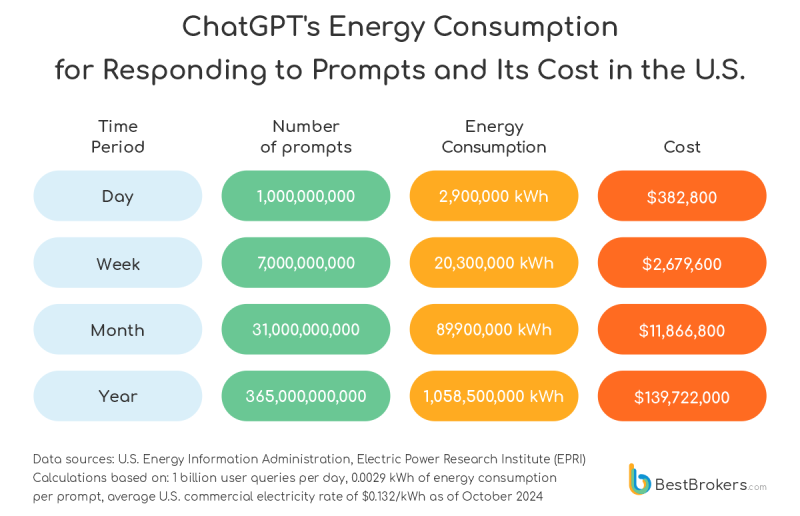
This article by Kasper Groes Albin Ludvigsen contains 2 calculations that estimate ChatGPT uses between 0.0017 and 0.0026 KWh of electricity to answer one query. (Paywalled, but you can view it here for free).
This data suggests that the energy used by GPT, would be enough to fully charge 223.4 million iPhones every day, for an entire year. In other words, that’s a lot of energy usage!
In fact, per search this is nearly x10 more than energy usage for a Google search which uses roughly 0.0003 kilowatt-hours per query (The Electric Power Research Institute). Quick caveat: ‘AI Overviews’ and ‘AI Mode’ challenge this.
In any case, a Google search is less resource heavy, and that’s because Google has been around for 20 years, which is plenty of time to make their operations more energy efficient. With GPT, we might not have that same amount of time.
These calculations are probably inaccurate, it’s hard to measure. But they do serve as example frameworks that a company could use to at least try and offset the impact. Or, an even easier way to do this is to stop claiming to be sustainable if you’re not really. 🙂
Same Problem But Bigger
Those in digital marketing know that the industry was already causing problems before LLMs came along. For decades the industry has been mass-producing content for the sake of clicks and rankings. You know, the articles that you land on from a Google search, where you need to scroll 30 meters into keyword soup and stock photos to get the one sentence you need.
This endless graveyard of rubbish may not seem harmful if no one’s visiting them. But it’s not that simple. Storing data still consumes power. When those junk pages live on physical infrastructure: hard drives, SSDs, server racks, backup systems. They’re also periodically crawled and indexed by search engines. The more junk content out there, the harder search engines like Google have to work to find the quality stuff. More crawling, more complex algorithms, more energy usage per search. As a direct result of the industry flooding the web with crap.
So, this isn’t anything new – it’s just on a bigger scale than ever before.
Planet Friendly (Terms Apply)
Why do companies want B-Corp status anyway… Is it because they genuinely care about the world, or because their prospective clients care? This is an easy one.
But realistically, what are companies supposed to do? Ditch GPT and go back to post-it notes? I wouldn’t suggest doing so. But if you do actually want to be sustainable, or at least claim to be – then this contradiction needs to be addressed. Everyone sees it, even if you’re not talking about it.
As a hypothetical client – I’d rather work with a company that’s honest about the resource problem, one that’s willing to say, “yeah, we do use AI, but we’re trying to understand the impact and figure out how to offset it”, because that stance is actually honest.
Meanwhile, companies who keep pumping out sustainability rhetoric whilst looking past this elephant in the server room? They may as well change their homepage banner to “full of shite”, because everyone is already thinking it.
Offset Ya’ Prompting
Some of you might be tempted by the option to sit around and wait for Sam Altman to announce “GreenGPT.” But I’m not holding my breath. The current trajectory is clear: more data, more servers, more computing power. It’s not slowing down.
And let’s be honest, if a cleaner version of GPT was even released, we wouldn’t use it. We like our conveniences, even if they are powered by 1,000 GPU cores and a lake’s worth of cooling.
The way I see it, we’ve got a few options:
- Estimate your AI usage and track it against carbon offsets.
- Dig up Tesla’s grave to ask about that perpetual energy machine he was working on.
- Stop spouting rubbish if you can’t follow through on it.
These words are my own and do not reflect those of my employer.